Box 11: Article 6, ECHR
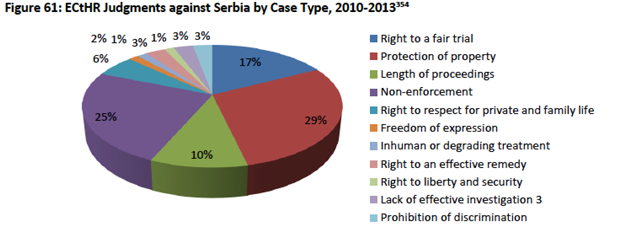
 With approximately 2,400 cases pending in 2012, another commonly found type of violation relates to non-enforcement of the final decisions against socially-owned enterprises. Between 2004 and 2009, the ECtHR rendered a number of judgments359 which found a violation of the applicants' right to a fair
trial due to the failure of Serbian authorities to take appropriate measures needed to enforce domestic judgments ordering socially-owned enterprises to pay salary arrears and employment benefits. In 2010, there were approximately 3,570 domestic judgments rendered against socially-owned enterprises in this respect with an aggregate amount of approximately 2.7 billion RSD (costs and interest not included). The Council of Europe’s Committee of Ministers therefore decided to monitor the implementation of general measures to address this particular issue.360 It asked the Serbian authorities to establish the exact number of unenforced decisions for
this type of cases. In March 2012, the Serbian Government
introduced a regulation in order to register the final
decisions ordering state-owned companies to pay employment arrears resulting in approximately 55,000 applications being filed as of September 2012. This scale indicates that the underlying problem may be primarily fiscal and economic rather than rooted in dysfunctions of the judicial system.
With approximately 2,400 cases pending in 2012, another commonly found type of violation relates to non-enforcement of the final decisions against socially-owned enterprises. Between 2004 and 2009, the ECtHR rendered a number of judgments359 which found a violation of the applicants' right to a fair
trial due to the failure of Serbian authorities to take appropriate measures needed to enforce domestic judgments ordering socially-owned enterprises to pay salary arrears and employment benefits. In 2010, there were approximately 3,570 domestic judgments rendered against socially-owned enterprises in this respect with an aggregate amount of approximately 2.7 billion RSD (costs and interest not included). The Council of Europe’s Committee of Ministers therefore decided to monitor the implementation of general measures to address this particular issue.360 It asked the Serbian authorities to establish the exact number of unenforced decisions for
this type of cases. In March 2012, the Serbian Government
introduced a regulation in order to register the final
decisions ordering state-owned companies to pay employment arrears resulting in approximately 55,000 applications being filed as of September 2012. This scale indicates that the underlying problem may be primarily fiscal and economic rather than rooted in dysfunctions of the judicial system.
Box 12: How Does Deferred Prosecution Work in Practice in Serbia?
Often referred to as ‘the principle of opportunity’, the public prosecutor is empowered to defer the prosecution of certain types of cases* and thus divert them out of the court system by offering suspects alternative conditions in lieu of a sentence. Conditions may include one or more of the following:
In practice, the prosecutor halts the prosecution for a specific time (which may not exceed one year) during which time the suspect must fulfil the obligation/s undertaken. Should the suspect not comply, the prosecution automatically re-commences with little further paperwork required. Competence for oversight of the fulfilment of obligations is performed by the Commissioner with the authority to execute criminal sanctions, in accordance with a regulation issued by the relevant minister responsible for the judiciary.
* The prosecutor may defer criminal prosecution for offences punishable by a fine or a term of imprisonment of up to five years. Deferred prosecution is not available in certain types of cases, such as family violence.
 Plea bargaining agreements enable prosecutors in
Serbia to negotiate charges and sentences in exchange for
a guilty plea by the defendant. The plea bargain has been
touted as a tool that enables the effective and efficient
disposal of cases in a manner that reduces the burden on
courts and prosecutors, freeing up their time and resources
which can then be devoted to contested cases.
Plea bargaining agreements enable prosecutors in
Serbia to negotiate charges and sentences in exchange for
a guilty plea by the defendant. The plea bargain has been
touted as a tool that enables the effective and efficient
disposal of cases in a manner that reduces the burden on
courts and prosecutors, freeing up their time and resources
which can then be devoted to contested cases.